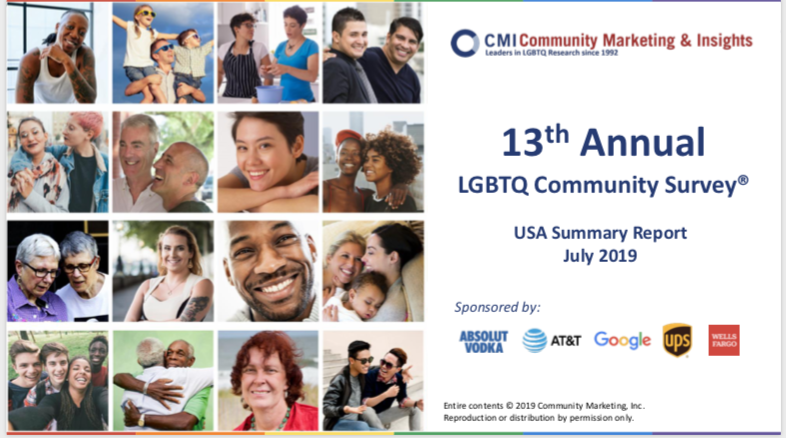
Key findings from CMI's 14th Annual LGBT Tourism Study have been compiled from responses from self-identified gay and lesbian consumers who read LGBT publications, visit LGBT websites, and attend LGBT events. With over 4,700 responses, this study polled more respondents than any other LGBT tourism survey, and offers valuable insights about consumers who may be reached through LGBT-dedicated marketing initiatives.
In addition to the Tourism Study, CMI produces online surveys, focus groups, field studies and customer satisfaction evaluations for a wide variety of clients including CVBs, DMOs and tourism offices, tour operators, hospitality groups, real estate developers, etc. In the year 2009 alone, CMI collected and analyzed over 100,000 gay and lesbian survey responses.
Based on tourism industry data from the US Department of Commerce and CMI sample demographics, the annual economic impact of LGBT travelers is approximately $63 billion in the US alone.
Throughout the report, distinctions of various LGBT markets are made based on gender, age, ethnicity, income, geographical location, etc. Below are samples of the findings from the US Profile of the report.
For the past 14 years, Community Marketing, Inc. (CMI) has been conducting its Annual Gay & Lesbian Tourism Study, the most comprehensive and longest-running such survey in the LGBT marketplace.
Many of the questions are asked in consistent ways to a similar study panel, in order to identify LGBT travel trends and changes over time. The following "top ten" list presents findings that the CMI research team views as important changes or observations from the past year. For those new to CMI's research, all the questions provide important insight into the travel motivations, preferences and interests of gay men and lesbians.
1) Gay Men and Lesbian Booking Patterns
Gays and lesbians are primarily booking their travel directly via airline and hotel websites (56%) or through online travel agencies such as Travelocity or Orbitz (34%). Direct booking is significantly more important than web-based travel services, so for travel suppliers, developing relationships with the gay and lesbian community to encourage direct booking through your own website is extremely important.
Travel suppliers and destinations having an LGBT "microsite" with dedicated content is a positive motivator for LGBT consumers.
2) For the First Time in 15 years of sampling -- A Decrease in LGBT Travel
For the first time since our first study in 1994, CMI has seen a decrease in LGBT travel due to the deep and wide-reaching recession. This survey, taken in October 2009, was far more pessimistic than CMI's survey taken in October 2008, which largely showed a net-even in travel patterns. In the 2009 survey, nearly all travel categories saw some loss (except for regional travel). Business travel and cruise travel were the hardest-hit categories. That said, far more LGBT travelers took cruises in the past year than their mainstream counterparts (as in previous years), indicating that LGBT travelers are a viable cruise market even in down economies.
3) Recession-Influenced Travel Decreases Affecting Small and Medium-Sized Markets Worse than Big Markets
Every major city in North America except for Washington DC (perhaps an Obama effect) saw a decrease in gay and lesbian travel over the past 12 months. That decrease affected cities very differently. Major markets, including New York City, San Francisco and Las Vegas saw only small leisure travel decreases, usually less than 5%, while medium sized cities, destinations that are geographically isolated, and some resort towns saw more significant decreases over 10%, and for some, over 20%.
4) Staycations
Staycations were the only travel category to see an increase in 2009. When asked to specify how many regional drive vacations (i.e. including at least one night in a hotel) were taken, 66% indicated taking a longer regional drive vacation of more than two hours; 42% took a regional drive vacation where the drive was two hours or less; 14% took a trip where they stayed in a hotel in their own city. This trend should benefit some metropolitan markets. Cities such as Boston, New York, Philadelphia and Washington DC, which are all close to each other, will probably "trade" stays among LGBT residents.

Also of note is the 14% of gays and lesbians who reported taking a staycation at a hotel in their own town, defined as a very short drive or via public transportation. While this number may be smaller, with dedicated promotions this could be a way of filling hotel rooms during slower periods, especially if packaged with other local activities.
5) How to Reach the LGBT Community
CMI has been tracking advertising trends for LGBT travel marketing for over a decade. In general, the survey shows substantive increases in the influence of traveler reviews on travel websites and blogs, a softening of the influence of banner ads on mainstream and LGBT websites, and a remarkable resilience of the influence of travel articles in LGBT and mainstream print publications.
6) Interest in Health and Fitness While Traveling is Down
CMI has seen a trend over the past few years showing that health and fitness while traveling are becoming less important to the LGBT community. In this survey, when given a long list of potential motivators, health and fitness-related responses were near the bottom of the motivators, and often last on the lists. From hotel gyms to health and fitness vacations, they all scored poorly. This is not to say that health and fitness are not important in the day-to-day lives of gay men and lesbians, but bringing these healthy habits with them on leisure or business travel has shown less importance over time. It could also indicate that with tightening budgets, LGBT travelers prefer to spend more time enjoying the sights and experiences of the destination, rather than spend limited time in a gym.
7) Pride Events are Important
Unaffected by recessionary influences, nearly a quarter of the respondents reported traveling to another city and spending at least one night in a hotel to attend a Pride event; same as previous years. Nationally, Pride events continue to move millions of hotel nights in the Unites States, and Pride remains an important motivator for LGBT travelers under 35.
8) Strength of Local Neighborhoods
Further confirming other recent research conducted by CMI, gays and lesbians tend to be especially interested in visiting city neighborhoods and experiencing local, non-chain restaurants. In fact, going to neighborhood restaurants and visiting the gay neighborhood were the top activities enjoyed by gays and lesbians when visiting a destination.
9) Top Travel Brands
As an unaided question, survey participants were asked to fill in a blank for in the destination, hotel brand, and airline that they felt had done the best job in outreaching to the LGBT community.

Of the total sample, 3,800 responded to the destination question. The top destinations indicated were: Las Vegas: 11%, San Francisco: 10%, Fort Lauderdale: 7%, Philadelphia: 6%, Provincetown: 5%, and London: 5%.

Of the total sample, 2,800 responded to the hotel question. The top hotel brands indicated were: W Hotels: 11%, Kimpton Hotels: 11%, Hilton: 9%, Hyatt: 8%, and Marriott: 7%.
Of the total sample, 3,287 responded to the airline question. The top airlines indicated were: American Airlines: 38%, Southwest: 15%, Delta: 11% and Virgin: 3%.
10) Top Destinations
CMI's list of top destinations remains amazingly consistent from year to year (based on the question of where did you travel in the past 12 months, and spend at least one night in a hotel). The following lists are reflective of the 4,726 American LGBT survey takers, who traveled to the city in the past 12 months and spent at least one night in a hotel:
Top 25 US Destinations for American LGBT Travelers, with percentage who visited and spent a nigt in a hotel (as Combined Leisure & Business Travel Ranking)
1) New York City: 32%
2) San Francisco: 27%
3) Las Vegas: 26%
4) Chicago: 25%
5) Los Angeles / West Hollywood: 24%
6) Washington, DC: 23%
7) Fort Lauderdale: 17%
8) San Diego: 15%
9) Orlando: 14%
9) Seattle: 14%
11) Boston: 13%
11) Philadelphia: 13%
13) Palm Springs 12%
13) Atlanta: 12%
13) Miami: 12%
16) Dallas: 11%
16) Denver: 11%
16) Phoenix/Tempe/Scottsdale: 11%
19) New Orleans: 10%
20) Napa County, CA: 9%
20) Provincetown, MA: 9%
20) Sonoma County, CA: 9%
23) Portland, OR 8%
23) Baltimore: 8%
23) Tampa/St. Pete: 8%
Top 5 US Destinations for American LGBT Travelers (as Leisure Travel Ranking)
1) New York
2) Las Vegas
3) San Francisco
4) Los Angeles / West Hollywood
5) Chicago
Top 5 US Destinations for American LGBT Travelers (as Business Travel Ranking)
1) Chicago
2) New York
3) Washington DC
4) San Francisco
5) Los Angeles
Top Canadian Destinations for American LGBT Travelers
1) Toronto
2) Montreal
3) Vancouver
Top European Destinations for American LGBT Travelers
1) England
2) France
3) Germany
4) Italy
5) Spain
Below are the top destinations for segments within the full LGBT panel:
Top 5 Destinations for American Gay Men
1) New York
2) Las Vegas
3) San Francisco
4) Los Angeles / West Hollywood
5) Chicago
Top 5 Destinations for American Lesbians
1) Las Vegas
2) San Francisco
3) New York
4) Los Angeles / West Hollywood
5) Chicago
Top 5 Destinations for American LGBT Seniors Age 62+
1) New York
2) Las Vegas
3) Los Angeles / West Hollywood
4) Fort Lauderdale
5) San Francisco
Top 5 Destinations for American LGBT Young Adults Age 18-32
1) New York
2) Las Vegas
3) San Francisco
4) Chicago
5) Washington DC
Permission to use this data is granted on the condition that all LGBT research references credit “Community Marketing, Inc., San Francisco, CA”
Click here to download CMI's Approach to Market Research.
Special cross-tab reports are available to assist marketers interested in more detail on sub-segments of the LGBT market. For further information please contact:
Thomas Roth or call Tom at 415/437-3800.
Download the entire report.